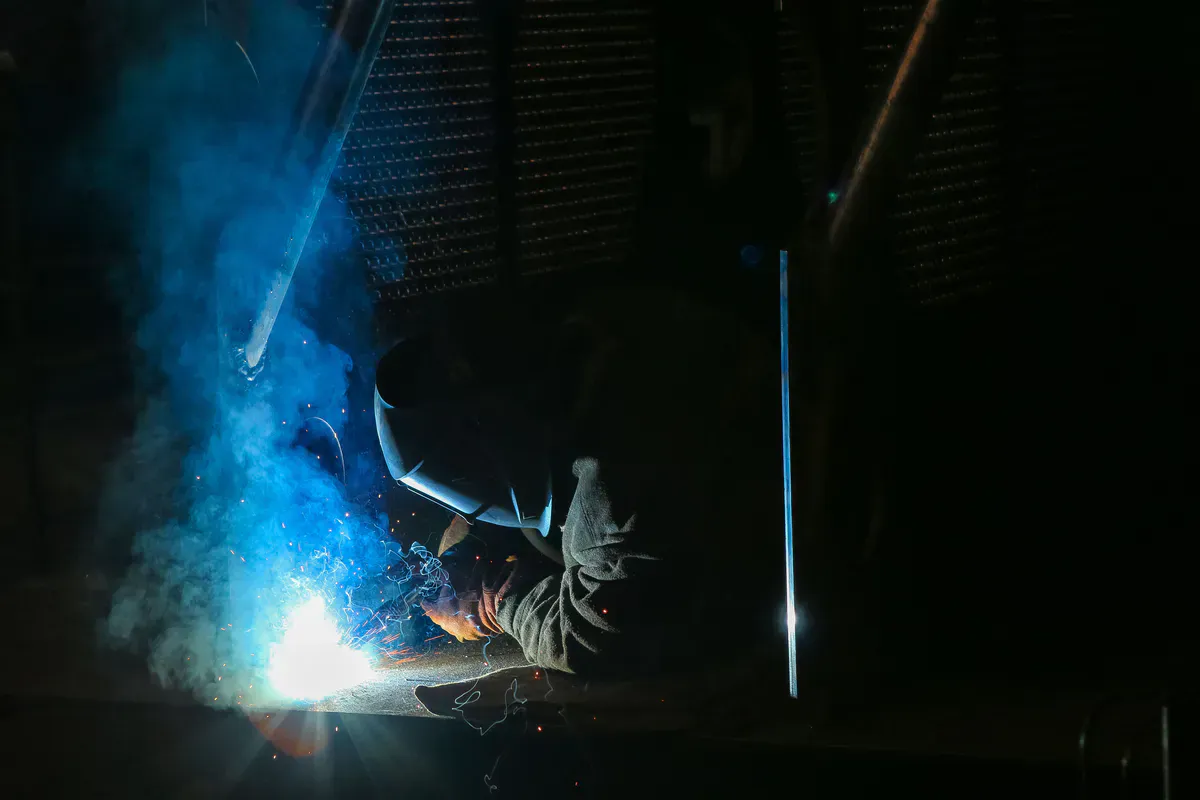
Welding is the trade that kills boots from above. Most boots die from the ground up, worn soles and cracked flex points. Yours die from hot metal landing on the tongue, slag burning pinholes through the upper, and laces that melt into little plastic knots. The boot that survives a fab shop is built different, and the differences are specific.
Before the picks, an honest note about this page. Our verified pool does not include a dedicated metatarsal-guard welding boot, and none of the boots below carries a spatter rating. Purpose-built met-guard welding boots exist beyond our verified picks, and if you work under heavy overhead spatter or drop stock regularly, that is the category to shop. What we can vouch for, spec by spec, are the leather all-rounders below that hold up to shop life. We would rather tell you that plainly than stretch a claim.
What a welding boot has to survive
Match the hazard to the spec. This table is about the job, not any particular boot.
| Hazard | What to look for |
|---|---|
| Spatter and sparks | Full-grain leather upper. Synthetics and mesh melt; leather chars slowly and shrugs off most of it. |
| Hot slag sitting on the foot | A design that sheds metal instead of catching it. Pull-on shafts and external met flaps beat open lace beds. |
| Exposed laces melting | Covered or minimal lacing. On a laced boot, leather laces outlast the synthetic ones that ship in the box. |
| Dropped stock and plate | A rated safety toe, plus a metatarsal guard if steel moves over your feet. The toe cap stops at your toes; the met guard covers the rest. |
| Hours standing at the table | Cushioned, removable footbed. Welding is a standing trade, and concrete collects its toll by the end of the shift. |
| Grinding dust and debris | A taller shaft. More leather between the boot top and your skin means less metal finding its way in. |
If your shop requires a met guard, that requirement settles the question and you should buy a dedicated welding boot. If your work is bench fab, tacking, and general shop duty where spatter is occasional rather than constant, a tough leather boot with a rated toe covers most days. That is the lane our picks live in.
Our picks, by tier
EVER BOOTS Tank S
A leather steel toe at a budget price. Meets ASTM F2413-11 with a steel shank underfoot. The boot you will not mourn when spatter scars it.
Check Price on AmazonCarhartt Rugged Flex 6"
Oil-tanned leather upper with a rubber toe and heel bumper and a cushioned EVA midsole for long bench days. Soft toe, so check your shop rules.
Check Price on AmazonThorogood 8" Moc Toe
American-made full-grain leather with a calf-high shaft. The extra height is the welding argument: more leather, less of you exposed.
Check Price on AmazonEVER BOOTS Tank S Steel Toe
The budget answer for a trade that eats boots. The Tank S is a leather work boot with a hard steel toe cap that meets ASTM F2413-11 impact and compression standards, which matters when plate and stock move around your bench. There is a steel shank in the build to take pressure off your foot on ladders and uneven ground, and the maker pitches it as wearable out of the box with no break-in.
The welding logic is simple. Spatter scars whatever you wear, so the boot taking the damage should be one you can replace without a hard swallow. You give up the premium touches, and the laces are a known weak point, but the core of it, leather over a rated steel toe, is the right core for shop work.
| Safety toe | Steel, meets ASTM F2413-11 |
|---|---|
| Upper | Leather |
| Outsole | Rubber |
| Shank | Steel |
| Insole | Removable |
- Rated steel toe at a budget price
- Steel shank for ladder and stair work
- Back loop for easy on and off
- No-break-in claim, removable insoles
- Reviewers report laces breaking within two months
- Some owners find them heavy and note slipping on concrete
- One reviewer had a sole fail inside three months
Carhartt Rugged Flex 6" Waterproof Soft Toe
The mid-tier pick earns its spot on the upper. Oil-tanned leather is the material you want between your skin and hot metal, and the Rugged Flex wraps it around a cushioned build, an EVA midsole with a polyurethane insole, that makes standing at a table all day less of a grind. A rubber bumper over the toe and heel adds protection where boots scuff first.
Know what you are buying. This is a soft toe boot, listed to ASTM F2892-24, so if your shop requires a rated impact toe, it is out. The Storm Defender waterproof membrane is a bonus for outdoor and site welding more than shop work. And the stock laces have a reputation: a thirty-five year boot wearer's chief complaint was that they will not stay tied. Synthetic laces near an arc are worth swapping for leather ones on any boot, this one included.
| Upper | Oil-tanned leather |
|---|---|
| Toe | Soft toe, listed to ASTM F2892-24 |
| Waterproofing | Storm Defender membrane |
| Midsole | EVA with polyurethane insole |
| Listed weight | 1.6 pounds |
- Oil-tanned leather upper, the right material for spatter
- Rubber toe and heel bumper for added protection
- Cushioned midsole for long standing shifts
- Waterproof membrane for site work
- No safety toe rating for impact, soft toe only
- Stock laces will not stay tied, per a long-time boot wearer
- Water resistance gets mixed reports from owners
- Some fit complaints about running large
Thorogood American Heritage 8" Moc Toe
The premium pick, and the one with the spec that matters most for welders in this pool: height. The 8 inch shaft sits calf high, and Thorogood builds it with flexible ankle support to keep you secure up top. For a trade where hot debris falls from above, more full-grain leather between your boot top and your shin is a real advantage, not a style point.
The rest of the build is the American-made package Thorogood is known for. Premium full-grain saddle leather, a fiberglass shank that holds its shape under heavy duress, and the MAXWear wedge outsole that meets ASTM F3445-21 slip-resistance standards and keeps its footing on wet and oily surfaces, which describes most fab shop floors. It is EH rated to ASTM F2892-18 as a bonus layer.
Two honest cautions. It is a soft toe boot with no met guard, so it is a shop boot, not an overhead-spatter boot. And the fit runs snug for some: an older review called it a little narrow, and sizing feedback is mixed, with some owners finding them larger than expected. Order with a fitting plan, not a guess.
| Upper | Premium full-grain saddle leather |
|---|---|
| Shaft | 8 inch, calf high |
| Outsole | MAXWear wedge, meets ASTM F3445-21 slip resistance |
| Electrical | EH rated, ASTM F2892-18 |
| Origin | Made in the USA |
- Tallest shaft in our pool, more coverage above the ankle
- Full-grain leather built at Thorogood's US plants
- Slip-resistant wedge sole rated for wet and oily surfaces
- Fiberglass shank keeps its shape under load
- Runs narrow for some feet
- Sizing reports are mixed, some say they run large
- Durability opinions are split, one owner reported damage after a day
- Soft toe, no met guard
How we choose: spec analysis against the safety standards, manufacturer documentation, and owner feedback, never invented field tests. The method is documented on how we pick boots.
Common questions
What kind of boots do welders wear?
Leather, high-shafted, and ideally without exposed laces. Spatter burns through synthetics and lodges in lace eyelets. Many welders run pull-on or metatarsal-guard boots so hot metal rolls off instead of sitting on the tongue.
Do welders need metatarsal guards?
Not every welder, but anyone working under heavy overhead spatter or dropping stock should consider one. A met guard covers the top of the foot, which a safety toe does not. Some shops require them, so check your site rules first.