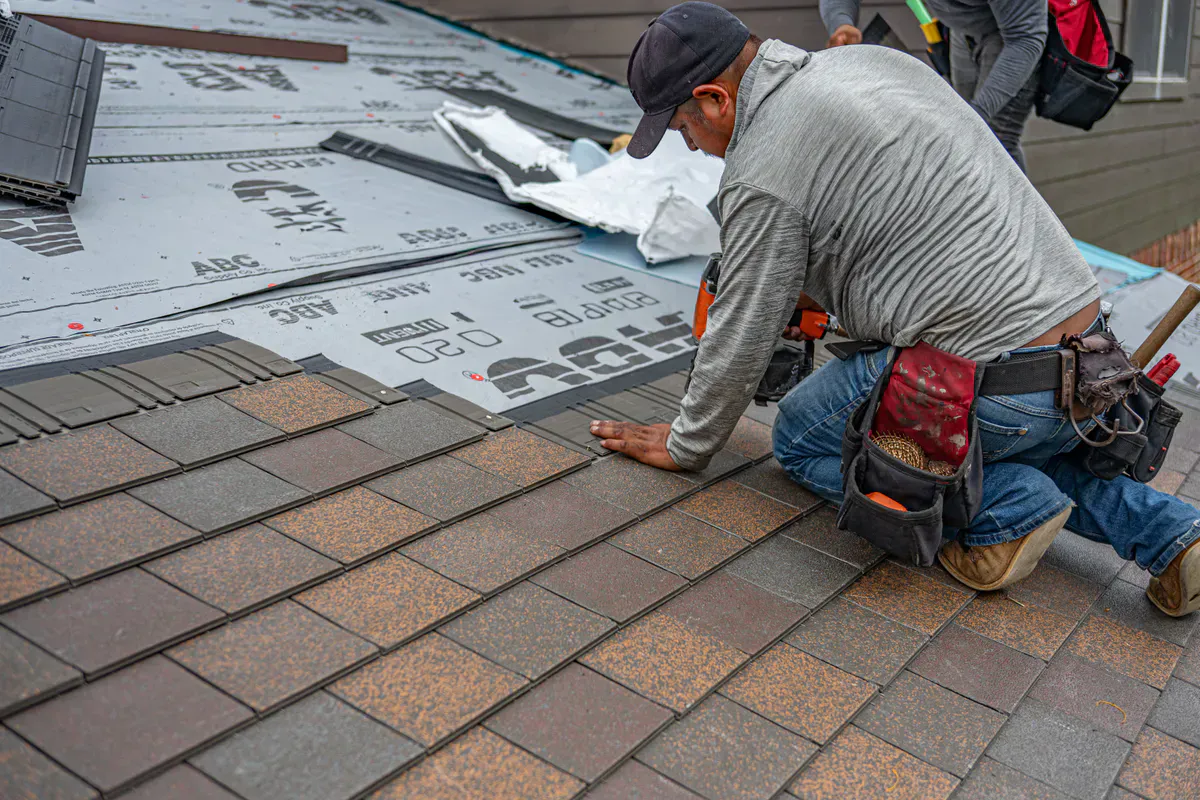
What a roof asks of a boot
Your working surface is at an angle, covered in granules, and sometimes hot enough to soften. You spend half the day crouched with your toes flexed against the pitch. A roofing boot has to do four things the average work boot does not:
- Grip with rubber, not tread depth. On shingles, the softer the compound and the more of it touching the deck, the better you stick.
- Flex at the ball. A stiff sole fights the crouch and pries itself off the pitch. You want a boot that bends where your foot bends.
- Keep the heel low. A tall, square heel edge catches on shingle courses and rolls ankles on the climb back to the ridge.
- Stay light. You carry every ounce up the ladder and across the deck all day.
Wedge sole vs lug sole on a roof
This is the choice that decides most of your traction, so it is worth getting the logic straight. A lug sole grips by digging. Its deep, widely spaced blocks bite into dirt, mud, and gravel, which is exactly right for ground trades and exactly wrong on a roof. Shingles do not let lugs dig in. The lugs reduce how much rubber touches the surface, and the gaps between them pick up loose granules and gravel that grind against the deck like ball bearings. A wedge sole grips by contact. It is one flat, continuous slab of rubber from toe to heel, so the entire footprint is touching the roof at once, and there is no separate heel edge to catch a shingle course. That is why wedge-sole moc toes are the default on residential crews. Lugs for the ground, contact area for the deck.
The specialist option we are not linking
Honesty first: there is a specialist brand roofers will tell you about, Cougar Paws, built around replaceable foam grip pads made for steep pitches. It owns that niche. We have not verified its current listings the way we verify everything we link, so there is no affiliate link and no spec table for it here, and we will not fake one. If you spend your career on steep-slope work, it deserves your own research. The picks below are the general-purpose route: flexible, low-heeled boots with verified specs that work on the roof and do not stop working when you climb down.
EVER BOOTS Tank (soft toe)
A light, flexible nubuck boot at a price that makes sense for a trade that eats soles.
Check Price on AmazonCarhartt 6" Moc Toe Wedge
A soft nubuck moc toe on a flat wedge outsole, the shape that keeps contact with the deck.
Check Price on AmazonThorogood American Heritage 6" Moc Toe
The slip-rated wedge that flexes, on a resoleable welted boot built to outlast its first outsole.
Check Price on AmazonEVER BOOTS Tank (soft toe)
The budget route, and a defensible one in a trade this hard on footwear. The Tank's upper is supple nubuck, pitched by the maker as support without restriction, and that flexibility is what you want with your toes bent against a pitch all morning. There is no safety cap adding weight, the collar is padded, and the insoles pull out if you run your own.
Be clear about what it is: a general construction boot that works on a roof, not a roofing specialist. The wide rubber sole is built for stability rather than for sticking to shingles, and nothing on the listing claims a grippy compound. For tear-off days, gofer duty, and roofers who want a cheap second pair that can also haul trash to the dumpster, it earns its slot.
| Toe | Soft toe, no safety cap |
|---|---|
| Upper | Supple nubuck, reinforced stitching |
| Sole | Wide rubber sole |
| Insole | Removable |
| Price band | Budget |
- Soft nubuck flexes with a crouched foot
- No cap weight to carry up the ladder
- Cheap enough to run as a dedicated tear-off pair
- Laces wear out fast per owners. Carry spares
- Wide width runs roomy for some buyers
- No grip-specific outsole claims. It is a generalist
Carhartt 6" Moc Toe Wedge
The shape is the argument. This is a soft, unlined nubuck moc toe on a flat Carhartt rubber wedge outsole, which is the silhouette roofing crews have defaulted to for decades: full sole contact on the deck and no heel edge to catch a course. Construction is Goodyear welt, so when the wedge wears smooth a cobbler can hang a new one, and the toe is a non-safety soft toe, which on a roof is usually exactly what you want.
Now the honest part, because this boot needs it. Its review record is the weakest of anything we list. Comfort feedback is polarized, with one owner blistered inside a ten-minute walk and another calling them perfect for casual use but a pass for work. It also runs big, with owners advising a full size down. If it fits your foot, the wedge shape is right for this trade and the welt makes it a keeper. Order carefully, expect to dial the size, and if you cannot try them on, the Thorogood below is the safer spend.
| Toe | Soft toe, non-safety |
|---|---|
| Upper | Soft, unlined nubuck |
| Outsole | Carhartt rubber wedge |
| Construction | Goodyear welt, resoleable |
| Insole | PU cushion insole |
- Flat wedge outsole keeps full contact on shingles
- Soft, unlined nubuck upper
- Goodyear welt means a resole instead of a replacement
- Comfort is polarizing, with blister reports even on short wear
- Runs big. Owners say size down
- Weakest owner-review record on this page
Thorogood American Heritage 6" Moc Toe
The premium wedge, and the one with the receipts. Thorogood's MAXwear Wedge outsole is built to flex more than typical work boot outsoles and meets the ASTM F3445-21 slip-resistance standard, with the maker rating it for loose gravel and wet and oily surfaces. Flex plus a slip-rated flat sole is the whole roofing brief in one outsole. Above it sits oil-tanned full-grain leather on a Goodyear storm welt, which both seals the sole seam against moisture and makes the boot resoleable when the deck finally eats the wedge.
It is American made, EH rated to ASTM F2892-18, soft toe, and carries a removable dual-density shock-absorbing footbed. Two cautions from owner feedback: fit is disputed, with a steady stream of reports that it runs narrow with a tight toe box, though some say the leather relaxes within a week or so of wear. There are also some reports of the sole separating at the toe, which is worth knowing on a boot whose toes spend all day pressed against a pitch.
| Outsole | MAXwear Wedge, ASTM F3445-21 slip rated |
|---|---|
| Toe | Soft toe, non-safety |
| Upper | Oil-tanned full-grain leather |
| Construction | Goodyear storm welt, resoleable |
| Electrical | EH rated, ASTM F2892-18 |
- Slip-rated wedge outsole built to flex
- Storm welt seals the seam and allows resoling
- American made full-grain leather that earns its premium band
- Removable shock-absorbing footbed
- Runs narrow with a tight toe box, especially before break-in
- Some owner reports of sole separation at the toe
- Premium price
None of these picks came from a staged rooftop test, and we will not claim one. We work from manufacturer specs, safety-standard documentation, and owner review patterns, written up in full on how we pick boots. New boots also deserve ground time before deck time, so read break-in done right before your first tear-off in them, and see the slip-resistant guide for what outsole ratings do and do not promise.
Common questions
What kind of boots do roofers wear?
Soft, sticky outsoles that grip shingles, flexible builds for crouching, and low heels that do not catch on the deck. Many roofers run wedge-sole moc toes. Specialist roofing boots with replaceable pads exist for steep-pitch work.
Are heavy work boots good for roofing?
Generally no. A stiff, lugged, heavy boot is built for ground work. On a pitch, lugs hold gravel that grinds shingles and stiff soles fight the angle. Roofing rewards the lightest, stickiest boot your site rules allow.