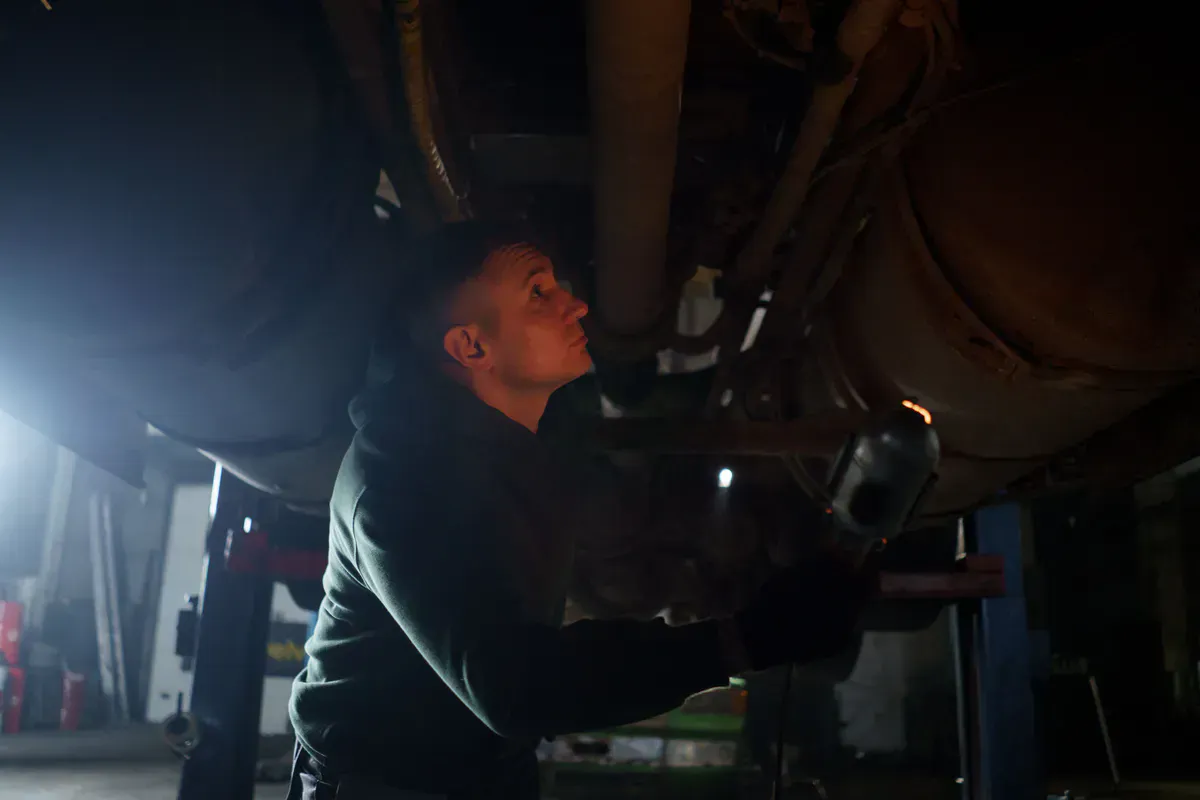
Shop work is a standing trade on the hardest floor there is. Concrete gives nothing back. Every step, every hour braced under a lift, every shuffle around a fender lands in your heels and stays there. Add the oil and coolant film that lives around every bay, and the spec sheet for a mechanic's boot writes itself: real cushioning between you and the slab, an outsole that holds on oily concrete, and as little weight as your shop's safety rules allow.
Weight matters more than mechanics usually give it credit for. You are not walking miles like a warehouse picker, but you are lifting your feet over creepers, jack handles, and air lines a few hundred times a day. A lighter boot leaves more in the tank at five o'clock. If your shop lets you choose your toe cap, our composite vs steel guide explains why composite is kinder on a cold slab. The picks below run steel and soft toe, because that is what our verified pool holds, and we say which is which.
What shop floors demand
| Shop reality | What to look for |
|---|---|
| Concrete all shift | A cushioned midsole and a shock-absorbing footbed. Thin board-stiff soles transmit everything. |
| Oil and coolant film | An outsole compound rated or described for oily surfaces, with tread that channels liquid out. |
| Dropped rotors, jacks, hubs | A rated safety toe if your shop requires one. Many do. |
| Creeper and crouch work | A lower-bulk boot that flexes at the ball instead of fighting your ankle. |
| Hot parts and chemicals | Leather over mesh. Mesh breathes until the first splash of something you did not want on your foot. |
Our picks, by tier
EVER BOOTS Tank
Soft toe nubuck leather with a wide rubber sole, arch support, and removable insoles. The budget standing-all-day boot.
Check Price on AmazonTimberland PRO Pit Boss
Steel toe with an outsole compound built for slip, oil, and abrasion resistance, plus a comfort system aimed squarely at foot fatigue.
Check Price on AmazonThorogood 6" Moc Toe
American-made full-grain leather on a slip-resistant wedge sole rated to ASTM F3445-21 and described for wet and oily surfaces.
Check Price on AmazonEVER BOOTS Tank Soft Toe
The Tank is the budget pick for shop duty that does not require a safety toe: lube techs, detail bays, mobile work out of a van. The case for it is comfort per dollar. Supple nubuck leather with reinforced stitching, a padded collar, and a wide rubber sole with what the maker calls excellent arch support. EVER BOOTS pitches it for hours of physical work, and the insoles come out easily if you run custom orthotics, which matters more in this trade than most.
Know its limits. There is no safety toe, so if your shop requires a rated cap, skip straight to the Pit Boss. And the facts from owners are plain: the stock laces get chewed up quickly, so buy spares with the boots, and the wide sizing runs roomy enough that one wide-footed buyer needed a second sock and said he would order standard width next time.
| Toe | Soft toe, no safety cap |
|---|---|
| Upper | Nubuck leather, reinforced stitching |
| Outsole | Wide rubber sole |
| Insole | Removable, takes custom orthotics |
| Shaft | Ankle height |
- All-day comfort focus at a budget price
- Removable insoles for orthotic swaps
- Owners call them comfortable, well made, and good value
- Padded collar and supple nubuck upper
- Laces wear out fast, owners say buy extras up front
- Wide sizing runs roomy
- Opinions about weight are mixed
- No safety toe for shops that require one
Timberland PRO Pit Boss 6" Steel Toe
The Pit Boss is the mid-tier pick because its spec sheet reads like it was written in a service bay. The outsole is Timberland PRO's heat-resistant rubber compound, described for enhanced slip, oil, and abrasion resistance. That is the oil-film answer, stated by the manufacturer rather than guessed at by us. Up top is a steel toe meeting ASTM F2412-18a and F2413-18 impact and compression standards, so dropped hubs and pry bars are covered, and the boot carries electrical hazard protection to ASTM F2892-18 as secondary insurance around live circuits and battery work.
For the concrete problem, Timberland PRO's 24/7 comfort suspension system is the pitch: it is designed to reduce foot fatigue, support the arch, and cushion every step. That is what you want under a standing trade.
The honest catch is sizing. Owner feedback on fit is genuinely all over the map. One reviewer sized down a full size, others recommend going up a half size, and one found them a bit wide for a non-wide size. Comfort and durability reports are mixed too, with some owners saying they hurt their feet and run small. Buy from somewhere with easy returns and expect to exchange once.
| Safety toe | Steel, ASTM F2412-18a and F2413-18 I/C |
|---|---|
| Electrical | EH protection, ASTM F2892-18 |
| Outsole | Heat-resistant rubber, enhanced slip, oil, and abrasion resistance |
| Comfort | 24/7 comfort suspension system, arch support |
| Materials | ReBOTL content, at least 50% recycled PET |
- Outsole built for slip, oil, and abrasion resistance
- Rated steel toe plus EH protection
- Comfort system aimed at fatigue and arch support
- Heat-resistant rubber compound near hot parts
- Sizing is a coin flip, reports run both small and wide
- Some owners say they hurt their feet
- Comfort and durability feedback is mixed overall
Thorogood American Heritage 6" Moc Toe
The premium pick is one of the best-selling work boots in its category, and the MAXWear wedge outsole is the shop-floor argument: it meets ASTM F3445-21 slip-resistance standards and Thorogood describes it as keeping you on your feet on wet and oily surfaces. The wedge profile puts full sole contact on the floor instead of heel-and-lug points, and the outsole is described as flexing better than other work boot outsoles, which your knees notice on creeper-and-crouch days.
Construction is the long-game case. Oil-tanned full-grain leather, Goodyear storm welt holding upper to midsole, a removable dual-density polyurethane footbed concentrated under the heel and ball strike zones, and EH resistance to ASTM F2892-18. Built at Thorogood's US plants. This is a soft toe model, so it suits shops that do not mandate a cap.
The fit warning is real: owners dispute whether they run true or narrow, and several found the toe box tight at first. One said the leather molded to his feet within a week and the tightness passed. Another went a half size up and found them way too long in the toe. Buy your length and let the leather do the stretching. There are also scattered reports of the sole separating at the toe, worth knowing at this price.
| Outsole | MAXWear wedge, meets ASTM F3445-21 slip resistance |
|---|---|
| Upper | Oil-tanned full-grain leather |
| Construction | Goodyear storm welt |
| Electrical | EH rated, ASTM F2892-18 |
| Footbed | Removable dual-density polyurethane |
- Slip-resistant wedge sole described for wet and oily surfaces
- Storm welt construction seals the sole seam and resists wear
- Shock-absorbing removable footbed
- Made in the USA
- Runs narrow for some, tight toe box until broken in
- Some owners report sole separation at the toe
- Soft toe only, no rated cap option here
The cheap upgrade: a real insole
Before you spend premium money chasing comfort, try fixing the floor problem from inside the boot. Factory footbeds are thin starting points, and every boot on this page has a removable one. The Orthobrace work orthotic insoles stack a polyurethane cushioning layer, arch support, a deep U-cup heel, and a gel shock pad, built specifically against the fatigue of prolonged standing on hard surfaces. Owners report comfort and help with leg fatigue. One honest caution from the reviews: a high-arch user found the size chart recommendation inaccurate, so check the measurements against your boot rather than trusting the size band, and trim to fit from there.
How we choose: spec analysis against the safety standards, manufacturer documentation, and owner feedback, never invented field tests. The method is documented on how we pick boots.
Common questions
What is the best work boot for working on concrete?
For shop floors, prioritize midsole cushioning, oil-resistant outsoles, and low weight. Concrete transmits every step back into your heels, so the difference between a cheap board-stiff boot and a cushioned one shows up by mid-afternoon.
Do mechanics need steel toe boots?
Many shops require a rated safety toe, and dropped rotors and jacks are real hazards. If your shop allows composite, it saves weight and does not conduct cold off a winter slab floor the way steel can.